Outside of the movies themselves, two events will seem to
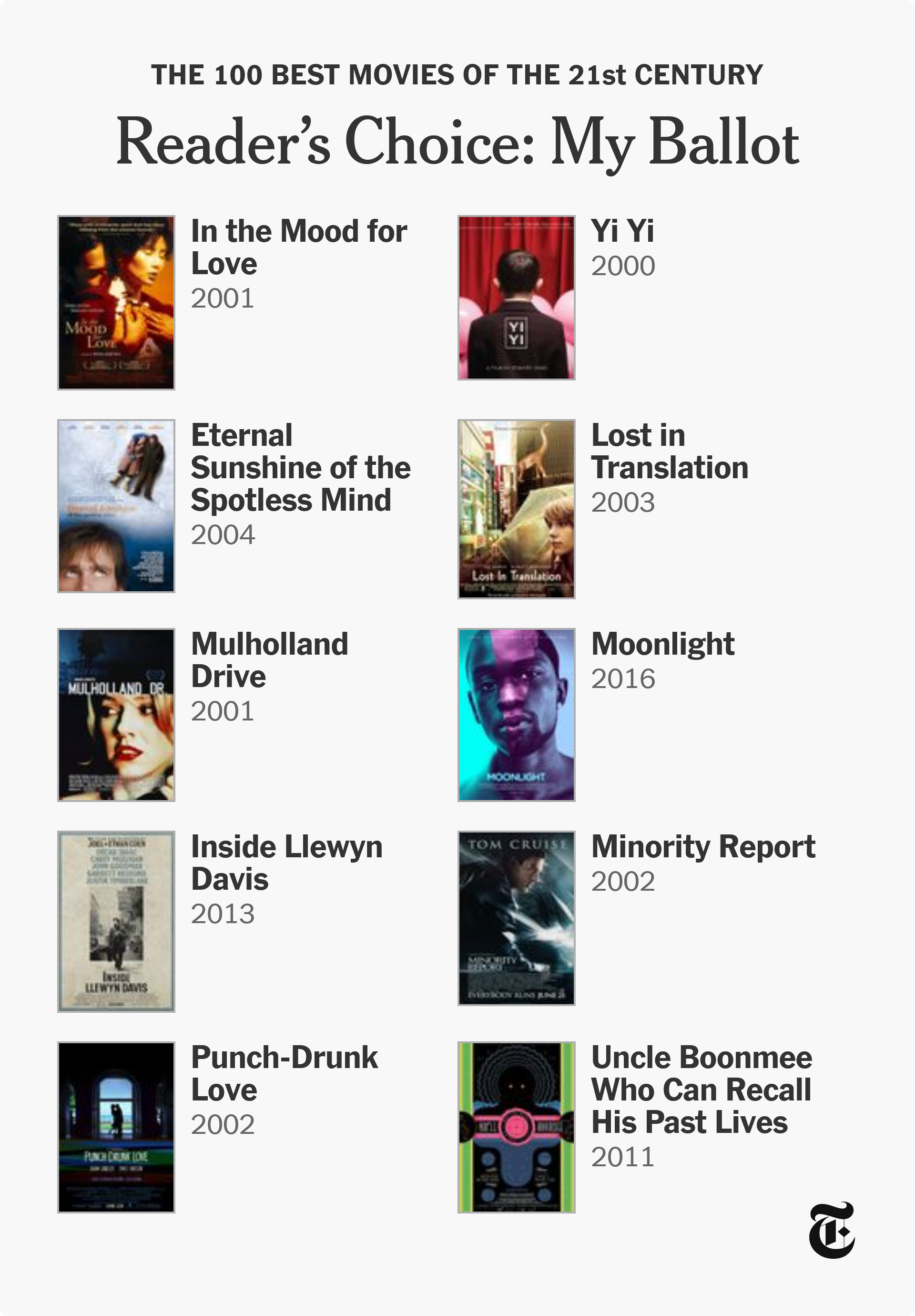
define the year in film 2025 for me: The New York Times poll of the best 100 movies of the 21st century
and the impending takeover of Warner Bros. by… well, we don’t know just quite
yet. The former is looking back, a celebration that, despite the disruption of
seemingly every industry since the turn of the century, proves movies are still
great. The latter though leaves anxiety for
the future, the subsuming of an iconic movie studio–the legacy studio of
all legacy studios–potentially by a company whose entire modus operandi seems
to be the elimination of movie theaters altogether or potentially by another
company that appears to be steadily morphing into the media apparatus of a
fascist regime.
For what it’s worth, here’s my NYT ballot (in ranked order
from left to right, top to bottom). While there are some expected entries, I
find it interesting that in a few cases, I swerved with the consensus on some
of the expected directors. I have the lowest ranked movie from the Coens and Paul
Thomas Anderson–Inside Llewyn Davis
and Punch-Drunk Love, respectively–and a Spielberg (Minority Report, a movie I feel like
I’m way higher on than just about anyone I know) that just sneaked onto the top
100. And while lists like these raise as many questions as they do ire amongst
its readers, what can be certain is that there will always be great movies, you
just have to know where to look for them. This list is a decent start.
I’d be remiss if I didn’t quickly conduct a brief in
memoriam. The year began and ended with the deaths of David Lynch and Rob Reiner, two directors who couldn’t be
more diametrically opposed, yet impacted the culture all the same. Two acting
stalwarts of the New Hollywood era and
beyond, whose stardom was matched only by their talent, Gene Hackman and Robert Redford also passed. But of course
the one that hit me the most was the passing of Diane Keaton, whose face has graced the top
of this very site since its inception, and whose performances are as
fundamental to my understanding of American cinema as anyone who has ever
stepped in front of a camera. La-dee-da.
Another deep roster of movies that made it difficult to rank them for this year's list. As always, there were some notable omissions due to not being able to see them in time--chief among them, The Zone of Interest and The Boy and the Heron, not to mention a slate of domestic and foreign art house titles that received no distribution in my neck of the woods and will have to wait until a streaming release later in 2024. But that said, still a terrific year for movies.
[Spoilers for the rankings below. Watch the above video first.]
From Once to Moonlight, from Only Lovers Left Alive to The Farewell, from Me and You and Everyone We Know to Lost in Translation, my pick for the top movie of the year more often has an air of melancholy--quiet, pensive movies you'd more likely see at the arthouse than at the multiplex (though that distinction feels weirdly dated). But for most of the year, I was prepared to write about how the top of my 2022 list would be a bit of an outlier, as I had two maximalist crowd-pleasers, two box office smashes (at least in relative terms) topping my list. Everything Everywhere All at Once and Top Gun: Maverick were my top 2 movies until very late December since having seen both of them before June. After watching Aftersun earlier in December, I "only" slotted it at #3. But in the intervening weeks, I haven't stopped thinking about it. The movie haunts in the same way the memories haunt its protagonist, Sophie. It's a shattering debut from director Charlotte Wells and as I was compiling this list, it felt inevitable that I had to place it at the top.
There were many movies I wished I could have caught up with before making the list: Armageddon Time, Women Talking, Jafar Panahi's No Bears (though his son Panah makes the top 10 with his moving debut!), All That Breathes, Pearl (the prequel to my #22, X), EO, Return to Seoul, and countless others.
As the Bowie clip at the beginning of the video suggests, a list of the best movies of the year is less an objective statement about the greatest films in any given twelve-month span than it is a story of how I traversed the movie year. It's a micro look at film history, a snapshot of one person's point-of-view. But the end of November gave us the opposite, a macro look at the art form, when the once-a-decade Greatest Films of All Time Critics' List was revealed by Sight & Sound magazine. There are better analyses out there than anything I could write and I'll link them below. But in some circles (to which I will not link below) will use the topping of the list by Chantal Akerman's Jeanne Dielman, 23, quai du Commerce, 1080 Bruxelles as an excuse to rail against political correctness, identity politics, and some vague and as always unformed idea of "wokeness", as an excuse to argue that the broadening of the voting base unfairly spits in the face of the traditional canon. To this I will only say that I disagree with this assessment and that even if these assertions are true, so what?
Not much to say. It was nice to finally get back into a movie theater this past year. Much like the previous year, it was difficult to see how the 2021 movie year would turn out. And as late as December, it looked like it would be a pretty weak year. But a flurry of movie watching in the last month brought me many of the year's best, an eclectic mix of American indies, foreign art house, direct-to-streaming titles, and Hollywood blockbusters.
Anyway, I hope you enjoy the video. Happy New Year!
There's almost certainly never been a weirder year in the history of the movies.
We will perhaps permanently lose our second biggest domestic theater chain. Most
major studio releases have been postponed in some cases more than a full year.
The traditional modes of production, distribution, and exhibition, already in
the throes of a years- or decades-long evolution is reaching a tipping point due
to the exacerbating circumstances surrounding the pandemic. AMC has already agreed to terms with Universal Pictures about an aggressive (and malleable) VOD strategy. Disney has released potential blockbusters to their own relatively young streaming service.
This isn't new. Netflix and iTunes started offering movies online over a decade ago. But we found out this year what it's like to live in a primarily virtual world. Well, that is of course not including the millions of frontline workers in healthcare and other service industries who never had that luxury, but I digress.
A growing revolution in the moving image hit its apex in ways that had little to do with what we consider "movies" in the traditional sense--and they came to us in a variety of directions. The first is clearly more pressing: cellphone footage of police brutality. Again, this isn't new. I'm old enough to remember quite vividly the Rodney King beating and the subsequent and volatile aftermath of that footage being released. But the recent acceleration in accessible technology has sadly made this an almost necessary tool to fight corruption and brutality. This all came to a head when the release of cell phone footage showing Officer Derek Chauvin's killing of George Floyd sparked nationwide (and eventually worldwide) protests of racial injustice. This came somewhat off the heels of footage being released of another senseless example of violence against a black citizen when white vigilantes shot and killed Ahmaud Arbery for the simple act of jogging.
On a hopefully lighter note, it's time to admit (begrudgingly) that the cell phone has not only become a dominant method for consuming content, but an increasingly viable way for creating it. In no way is this more apparent than the explosion of TikTok, the social network for creating short videos. (Even I joined it because, well, my friends made me.) Instagram's stories and reels features also fill this growing niche of video creation that puts the content directly in the hands of the consumers. And yes, many of these videos are nonsense. Some are charming sure, others little more than the narcissistic Facebook or Twitter posts of past years turned into a moving image.
Then there are the things that make you happy humanity didn't completely fall apart in the year of all years that it could have. As Broadway theaters have shut their doors, a crowdsourced musical version of Pixar's Ratatouille began to spring up on TikTok. Aspiring musical theater artists wrote and performed original songs, dancers choreographed their own numbers, and costume and set designers worked on production material for a show that didn't even exist. And the result was one of the most truly wonderful things in 2020, eventually leading to the somewhat professional streaming adaptation that dropped just as the year turned.
But if you're reading this, you're here for the movies. I feel like I say this every year, but there is no real point in trying to find a theme in any particular year's movies, no connective tissue to the myriad of films that happened to be released within a given specified calendar range. Movies that were lucky enough to get released in any format this year were created (at least for the most part) without the knowledge of what was to befall the world in the coming months.
And yet...
Many of the films that made my list express some sort of dissatisfaction or disillusion with the world, be it political or personal or both. These films either confront the various horrors of the world today--misogyny, sexual and racial violence, xenophobia, income inequality--or provide the needed respite from needing to constantly engage with them. Some of the very best of these are able to do both.
I'd be lying if I said the lack of bigger budget Hollywood fare changed the makeup of this year's list. Those types of movies tend to be outliers for me at least in terms of what I think the best of the best are. Yet speaking more broadly, it is perhaps that the noise created by the hype surrounding these tentpoles have quieted enough to make room for the smaller and more personal and idiosyncratic works. So, like the hope some had that the limitations to travel over the past year would reap some environmental benefits (turns out it didn't really), perhaps nature could have a hand in course correcting the cinematic landscape as well.
This is an eclectic list and while many lament what would seem like a lack of significant movies over the past year, like any other, I still had a tough time narrowing down my favorites and I am still filled with regret for the handful of titles I had to leave off*. Though we weren't able to see a number of nine-figure budgeted movies, 2020 was I think a real bright spot for American independent cinema. Young, up-and-coming directors with few titles to their name and veteran indie filmmakers alike are all over this list. And book-ending the top 10 are two incredibly disparate titles from a bona fide American master, one who can toggle seamlessly between big and low budget, narrative and documentary, yet whose stamp is unmistakably written on every frame.
*I will list them here, in the hopes you'll seek these out too:
Driveways (Andrew Ahn)
Vitalina Varela (Pedro Costa)
The Woman Who Ran (Hong Sang-soo)
The Invisible Man (Leigh Whannell)
Mangrove (Steve McQueen)
Palm Springs (Max Barbakow)
Soul (Pete Docter)
Mank (David Fincher)
Time (Garrett Bradley)
What the Constitution Means to Me (Marielle Heller & Oliver Butler)
I feel like I say it every year: "It's been a great year for movies." And 2019 was no exception--in fact, it was one of the best years for movies that I can remember. Each year I keep a running list of movies that would make a potential best-of list and for the first time that list reached triple digits. Certainly, a large number of those movies had no real shot of making a top 10 or 25 list of the year's best, but it goes to show how deep 2019's slate really was. Even with that, I still feel like I missed a handful of movies that may have been included had I been able to screen them in time.
As always, the final list is in order of how I felt at the moment I finalized it. Ask me in two weeks or two months, something between 15-25 could be in the top 10 or something in my list of honorable mentions (see below) would be in the video. What feels like fixtures, though, are the two titles at the top of the list. There are a several things going on in each of those films: the internal conflict between coming of age in the West, but having your heritage come from the East (The Farewell); the options (or lack thereof) one has in deciding the path they take in life as a woman (Little Women). But what struck me about each of those is that they depict how time and circumstance can slowly pull a family apart. That as we age, even the closest of family bonds need tending to lest they wither away. It's something I've thought about a lot in my life recently and while these two films are much richer than just this aspect, it's perhaps why they seemed to have resonated with me more deeply than others.
I've long praised the quality of the releases from the production/distribution company A24. They are to me what perhaps Focus Features was in the early 2000s, a company that wisely devotes its resources to idiosyncratic auteurs who make personal films that, with regularity, end up being among my favorites of the year. Six A24 releases make the top-25 video above and another two make the honorable mentions below. That also makes 3 out of the last 4 years in which they claimed the #1 spot (Moonlight, 2016; A Ghost Story, 2017).
It almost pains me to have left so many other wonderful films off the video. So in the hopes you'll search some of them out and in honor of 2020, here are 20 more movies I loved released over the past 12 months. Here's to another great movie year.
3 Faces (Jafar Panahi) The Art of Self-Defense (Riley Stearns) Asako I & II (Ryūsuke Hamaguchi) Ash Is Purest White (Jia Zhangke) The Beach Bum (Harmony Korine) Climax (Gasper Noé) The Dead Don't Die (Jim Jarmusch) Diamantino (Gabriel Abrantes, Daniel Schmidt) Dragged Across Concrete (S. Craig Zahler) First Love (Takashi Miike) Ford v Ferrari (James Mangold) I Lost My Body (Jérémy Clapin) The Image Book (Jean-Luc Godard) The Lighthouse (Robert Eggers) The Nightingale (Jennifer Kent) Non-Fiction (Olivier Assayas) One Child Nation (Nanfu Wang, Zhang Jia-Ling) Pain and Glory (Pedro Almodóvar) Starfish (A.T. White) Waves (Trey Edward Shults)
Allow me a quick sports analogy. Some time in mid-December, a show dedicated to the NBA discussed the lack of a clear-cut MVP candidate. That for the first time in several years, the race seems to not be limited to one or two obvious choices, but a wide range of players.